Will A Hotel Hold My Luggage If I’m Not Staying There?
The honest answer for Paris: most hotels say no to non-guests, why the front desk refuses, what French law covers, and the bookable drop-off points that say yes.
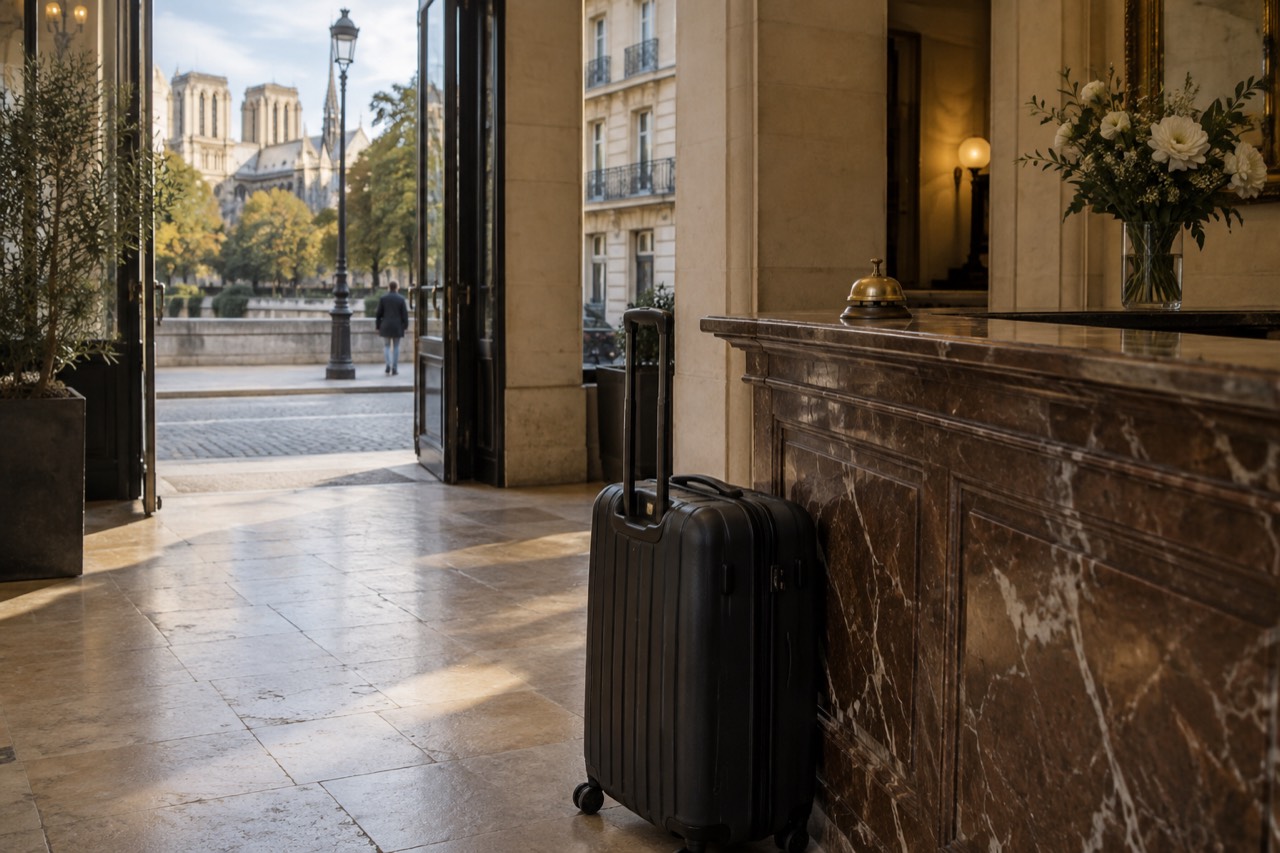
Will A Hotel Hold My Luggage If I’m Not Staying There?
Most of the time, no. A Paris hotel front desk will usually hold bags only for people staying, or who have stayed, at that hotel, and there is no published chain policy anywhere promising otherwise. No major Paris chain publishes a non-guest luggage policy at all, so the answer depends entirely on the person at the desk, and the honest expectation is a polite refusal.
It is a reasonable question, and an extremely common one. You have checked out of your own hotel at noon, your train leaves at eight, and there is a perfectly nice hotel right next to the museum you want to see. Surely the desk will take one suitcase for three hours?
Sometimes it works. More often it does not, and the reasons are practical rather than unfriendly. A hotel luggage room is an unstaffed back room with finite shelf space, and every bag in it belongs to a guest the hotel can trace to a room number, a passport scan and a card on file. A stranger's suitcase is none of those things. If the hotel later cannot find it, or the stranger never comes back, the hotel has no name, no address and no payment to fall back on. Refusing walk-ins is the low-risk answer, and desk staff are trained to give it.
There is also a security dimension that Paris hotels take seriously. An unattended or unexplained bag inside a hotel triggers the same instincts it triggers in a train station: French stations publish an average of 19 minutes to deal with a single unattended bag, and the law of 28 April 2025 set fines for abandoned luggage on the rail network at 72 to 1,500 euros depending on circumstances. A hotel is not a station, but the reflex has spread. A desk clerk who accepts an anonymous bag is accepting a small, non-transferable liability for a person they cannot identify.
That is the honest core of this article: the no is real, it is not personal, and it is exactly why bookable luggage storage exists in Paris. Every storage point recommended on this site is a real Radical Storage partner location, and this site neither owns nor operates any of them. That disclosure matters here more than usual, because the whole question is about handing your suitcase to a stranger.
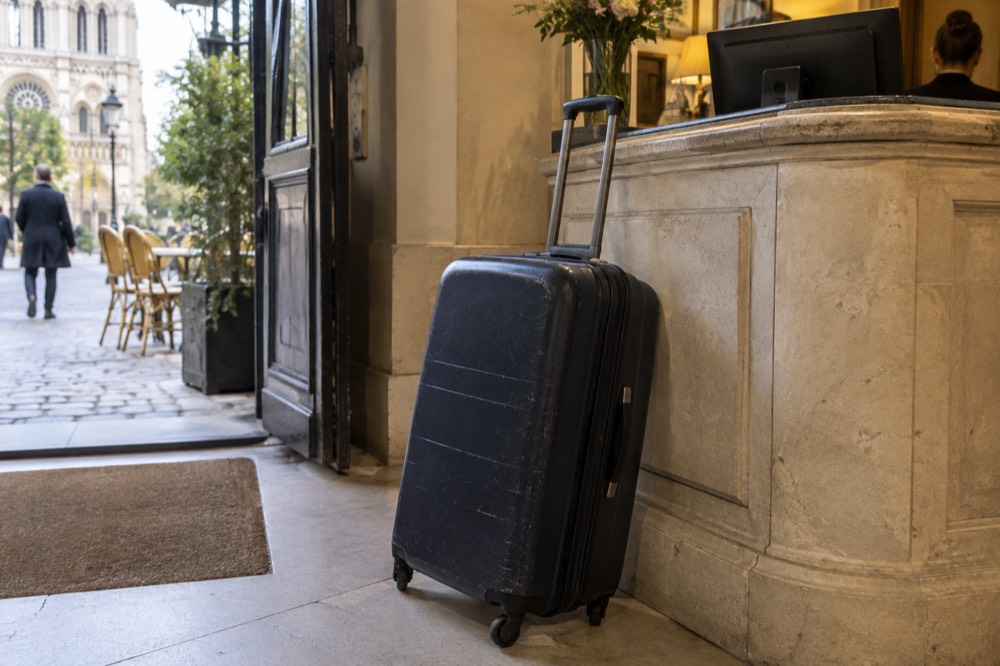
If the hotel route fails, the fastest fallback is a booked drop-off point near wherever you are actually spending the hours. Near the Louvre, for instance, there are five Radical Storage points, rated 4.8 across 3152 reviews, opening as early as 07:00 and closing as late as 22:00. The three options below cover the three situations this article's readers most often land in: a museum morning, a Catacombs visit where suitcases are banned outright, and a Bercy or Autolib-style eastern-station departure.
Why The Front Desk Says No To Walk-Ins
A hotel that holds a non-guest's bag takes on responsibility it has no legal framework for, no shelf space budgeted for, and no way to charge for. French hotelkeeper liability law is written around people who lodge at the hotel, so a walk-in bag sits outside the rules the hotel actually understands. Saying no costs the hotel nothing; saying yes costs it an undefined risk.
Start with the practical layer. A Paris hotel luggage room, where one exists, is sized for the property's own checkout flow: a wave of bags at noon, collected in a trickle by early evening. On a busy Saturday that shelf space is already spoken for. A walk-in suitcase competes with paying guests' bags for the same square metres, and the desk clerk has no authority to price the intrusion even if they wanted to. Some independent hotels will improvise a small fee; most chains simply prohibit the practice, and no Accor, Marriott, Hilton or Citadines property publishes a written non-guest luggage policy for Paris that a traveller could point to at the desk. That absence is itself the answer: if it were a service, it would be on the services page.
Then there is the identification problem. A guest's bag is logged against a room, a name and a payment card. A walk-in's bag is logged against nothing but a verbal promise to return. If two identical black suitcases come off the shelf, or a bag goes missing, the guest has a paper trail and the walk-in has a description. Desk staff know this, which is why the refusal is usually immediate and not a negotiation.
The security reflex finishes it. Since the April 2025 transport-security law, an unlabelled bag left on the rail network can draw a 150 euro fine, rising to 750 euros, and SNCF and RATP now hand out free anonymous QR-code luggage labels in stations to combat exactly this. Hotels watch the same news. A bag from a person the hotel cannot identify is, from a security standpoint, the thing the whole city has spent a decade learning to treat with suspicion. The clerk is not being difficult; they are following the grain of the city.
For the traveller, the useful conclusion is to stop treating the hotel desk as a storage option and treat it as a last resort. A booked point costs a known amount, has published hours, and comes with a guarantee structure, discussed below, that at least exists in writing. The Louvre cluster is the busiest in the city for exactly this reason: it is where the museum's own free lockers stop at 55 x 35 x 20 cm and the suitcase has to go somewhere.
Near the Louvre, storage runs EUR 3.90 per bag per day, and a EUR 1.99 per-bag fee is added at checkout, so one bag for one day works out to EUR 5.89 in arithmetic on those two published figures. That is the number to compare against the value of an afternoon without a suitcase, and against the risk of a desk refusal that leaves you standing on a pavement with nowhere to put the thing.
What French Law Actually Says A Hotel Owes You
For a guest, French law caps a hotel's liability for lost or damaged effects at one hundred times the nightly room price, under Civil Code article 1953, unless the guest proves the hotel was at fault. For someone who never lodged there, the regime is far murkier, and no published source settles what a hotel owes a non-guest whose bag it agreed to hold.
The guest-side rule is real and worth knowing even as a walk-in, because it explains the desk's caution. Under article 1953 of the French Civil Code, a hotelkeeper's liability for a guest's clothing, luggage and effects is capped, to the exclusion of any lower contractual limit, at one hundred times the daily room price, with a lower cap of fifty times for items left in vehicles on premises the hotel controls. A consumer-rights summary of the same rule is published by INC, the French national consumer institute. So even a guest whose suitcase vanishes from the luggage room is recovering against a formula tied to the room rate, not against the bag's value.
Now apply that to the walk-in. The underlying liability in article 1952 attaches to travellers who lodge at the hotel, the deposit being a necessary one. Whether a hotel holding a non-guest's bag falls under the same regime, or under ordinary contractual or gratuitous-bailment rules, is a legal question with no published French answer this site could source. It is not law that the hotel owes you nothing; it is law-shaped fog. A business asked to accept an undefined liability, for no fee, from a stranger, will decline. That is not Paris rudeness, that is a rational reading of an unclear statute.
The comparison with a booked storage point is instructive precisely because the liability is written down. Radical Storage advertises a EUR 10,000 guarantee, and its binding terms cap payment at EUR 3,000 per claim and state that the guarantee "is not an offer to insure your property and does not constitute a contract of insurance". Those two figures belong together, always. A reader deciding whether to leave a laptop in the bag needs the cap, not the headline. Claims must be notified within seven days of discovering the loss, and a signed, itemised list of the bag's contents with estimated values is a condition of any claim, so photograph your packed bag before you hand it over. Theft claims additionally require a police report within 48 hours.
None of that makes a storage point legally bulletproof. It makes it legible: the rules exist, they are published, and you can read them before you hand over the bag. The hotel walk-in offers the opposite, a verbal "yes, fine" with no written terms at all. When the question is whose guarantee covers your suitcase, Luggage Storage in Paris takes the view that a named network with published terms beats an unnamed favour, every time.
Put plainly, if your plan for the afternoon rests on a hotel favour, you are leaning on goodwill that nobody has written down anywhere. If it rests on a booked point, you are leaning on published hours, a fixed price and a guarantee with a stated cap. That difference is the entire decision, and it is why this site exists.
When A Hotel Might Say Yes Anyway
Small independent hotels, hotels with a staffed desk and visible luggage room, and hotels where you are a returning or future guest are the realistic yes cases. The ask works best mid-morning or mid-afternoon on a weekday, offered with a tip and a specific pickup time, and it almost never works at large chain front desks during checkout rush.
The pattern in traveller reports, hedged and anecdotal as they are, points to a few consistent soft spots. A family-run hotel with three staff and a hallway behind the desk will sometimes take a bag for a few hours, especially if you buy a coffee at the bar or leave a tip. A hotel where you stayed last night, or where you are staying tonight, is a different question entirely: holding a bag before check-in or after checkout is a normal guest service, and covered in our separate guide to how Paris hotels handle luggage for their own guests. A hotel where you have a future booking may also say yes, because you are traceable in their system.
What does not work is the anonymous ask at a busy property. A 200-room chain hotel at 11:45 on a checkout Saturday has a queue of actual guests; the clerk's incentive is to clear it, and the fastest way to clear it is to decline anything off-script. The same hotel at 15:00 on a Tuesday, with one clerk and an empty lobby, might say yes to the identical request. Timing and scale matter more than charm.
| Situation | Realistic answer | Why |
|---|---|---|
| You stayed last night, asking after checkout | Yes, usually same day | You are a traceable guest; standard practice |
| You have a booking tonight, asking in the morning | Yes, usually | You are in the system with a card on file |
| Small independent hotel, quiet hour, with a tip | Sometimes | Staff discretion, low pressure, small favour |
| Large chain desk, checkout rush, no booking | No | Off-script liability, queue pressure, no trace |
| Any hotel, overnight or multi-day non-guest bag | Almost never | No framework for a long deposit from a stranger |
One more honest note: even the yes cases are favours, not services. There is no receipt, no guarantee, and, as the legal section above sets out, no clear rule on what the hotel owes you if the bag is lost. If the bag contains anything you would be upset to lose, the favour is the wrong instrument. Our guide on whether hotel luggage storage is safe works through the same trade-off for guests, and the non-guest version is strictly worse.
What A Booked Storage Point Gives You Instead
A booked Radical Storage point gives you a named location with published hours, a flat per-bag day rate, a written guarantee capped at EUR 3,000 per claim, and a QR-coded handover that logs who took your bag and when. It is a transaction with terms, which is precisely what the hotel walk-in cannot offer.
The mechanics are simple. You reserve a point, pay the day rate of EUR 3.90 per bag plus the EUR 1.99 per-bag checkout fee, and receive a QR code. At the point, usually a shop, cafe or hotel counter, the code is scanned, the bag is tagged and stowed behind the counter, and you walk away with your hands free. Hours are set by each individual point, not by the network: this site's records show Paris points opening as early as 07:00 and closing anywhere from 20:00 to 23:59, so the hours on the specific point's card are the ones that matter, never a generic claim. Free cancellation applies any time before the scheduled check-in, which makes a speculative booking cheap to change.
The guarantee deserves its honest paragraph. Radical Storage advertises EUR 10,000; the terms cap it at EUR 3,000 per claim and state plainly that it is not insurance. Items are valued at current market value minus wear and tear, and sentimental value counts for nothing. A claim needs a signed itemised list of contents, notification within seven days, and a police report within 48 hours for theft. Read that way, the guarantee is a real but modest backstop, and the practical takeaway is not to store valuables you cannot afford to lose, in a hotel favour or a booked point alike.
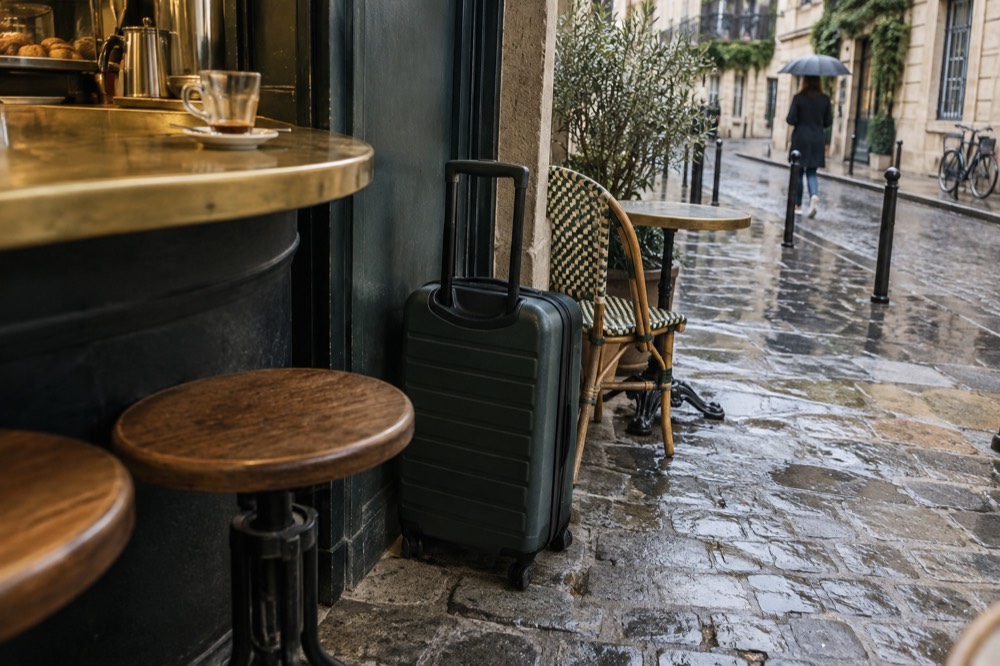
Where the booked point beats the hotel ask most decisively is at the sights that ban suitcases outright. The Catacombs refuse any bag over 40 x 30 x 20 cm and have no cloakroom at all, because the exit is 700 metres from the entrance; the Palais Garnier bans travel luggage under the Vigipirate plan and keeps its cloakroom closed during daytime visits; the Conciergerie lists bulky luggage among prohibited items at its X-ray checks. At every one of these, the plan cannot be "ask the hotel next door", because the hotel next door is a monument with no storage at all. The nearest bookable points are the only real answer, and the Catacombs cluster runs the same EUR 3.90 day rate plus the EUR 1.99 fee, with points rated 4.72 across 344 reviews and opening as early as 05:00 for early-entry ticket holders.
What It Actually Costs, Hotel Favour Versus Booked Point
A hotel favour is free when it happens, which is its whole appeal, but it is unreliable and unbacked. A booked point is EUR 3.90 per bag per day plus a EUR 1.99 per-bag checkout fee, EUR 5.89 for one bag for one day in arithmetic on the published figures, and the fee is charged once per bag regardless of how many days you store.
The per-bag, once-per-booking structure of the checkout fee is worth spelling out, because it changes the maths on multi-day storage. One bag for three days is EUR 3.90 x 3 plus EUR 1.99, which is EUR 13.69: the day rate scales, the fee does not. Two bags for one day is EUR 3.90 x 2 plus EUR 1.99 x 2, which is EUR 11.78. Quoting the day rate alone, as most pages do, understates a one-day booking by about a third, which is why this site shows the fee every time it shows a price.
Against the official SNCF station consignes, the comparison is genuinely two-sided and worth knowing before you assume the network is always the answer. At Gare du Nord the staffed consigne charges EUR 4.00 for up to four hours, cheaper than any network booking for a short stop, but EUR 9.50 for 12 to 24 hours, well above EUR 5.89. At Gare de Lyon the lockers run EUR 5.50 to EUR 9.50 for a fixed 24 hours. And at Saint-Lazare and Bercy there is no in-station consigne at all, so a network point is the only realistic option in that half of the city. Our full comparison of Paris bag storage versus the station consigne works through the arithmetic station by station.
| Option | Cost for one bag, one day | Reliability | Backing if something goes wrong |
|---|---|---|---|
| Hotel favour (non-guest) | Free, or a small tip | Unreliable, discretionary | No written terms; legal position unclear |
| Radical Storage point | EUR 3.90 + EUR 1.99 = EUR 5.89 | Bookable, published hours | Guarantee capped at EUR 3,000 per claim, not insurance |
| SNCF consigne, Gare du Nord | EUR 4.00 up to 4 hours; EUR 9.50 for 12-24 hours | Can be full; SNCF says so itself | SNCF station service, fixed tariff |
| Disneyland Guest Storage | EUR 5 to EUR 15 per item per day | Cannot be booked in advance | Disney disclaims liability for belongings in the parks |
The Disneyland row is there for a reason: it is the most expensive per-day storage published anywhere in this site's research, at EUR 15 for a large item, and it cannot be reserved in advance, which is the same unreliability problem as the hotel favour, at fifteen euros. The pattern across the whole table is consistent. Free or cheap options are the ones you cannot book; the ones you can book cost a known five to six euros and hold your slot.
How To Ask So You Get A Straight Answer
Ask early, ask small and ask specific: a named pickup time, one bag, a quiet hour, and an offer to pay or tip. If the answer is no, do not escalate; the clerk has no authority to change it, and the booked-point fallback takes about three minutes to arrange on a phone.
There is a way to ask that maximises your odds, and it costs nothing. Go in person rather than calling, because a face makes the favour concrete. Lead with the specifics: "One small suitcase, three hours, I will be back at four o'clock, I am happy to pay." A named time turns an open-ended liability into a bounded one, and offering payment signals you understand you are asking for something. Choose your moment: mid-afternoon on a weekday at a small hotel with an empty lobby is a different universe from a chain desk at checkout. If you are staying at the hotel tonight or stayed last night, say so first, because that changes the category of the ask entirely.
If the answer is no, accept it. Pushing rarely converts a no into a yes in Paris, and the clerk who refused at 11:00 is not going to be worn down by 11:05. The productive move is to open the Radical Storage map on your phone and look at what is within a few minutes' walk. In the areas travellers actually spend these hours, the Louvre, the Marais, Montmartre, the Latin Quarter, Gare de Lyon, the network is dense enough that the nearest point is usually closer than the hotel you just tried. Our guide to storing luggage for a few hours in Paris maps the short-stop clusters in detail.
One last practical habit, wherever the bag ends up: photograph the contents and the packed bag before handover. At a Radical Storage point, a signed itemised list with values is a condition of any claim under the terms, and at a hotel favour there are no terms at all, so the photo is the only record that exists. It takes thirty seconds and it is the single highest-value thing you can do in the entire luggage-storage process, wherever your suitcase spends its afternoon.
The honest summary of this whole question: the hotel walk-in is a lottery ticket, the station consigne is cheap but finite and absent at Saint-Lazare and Bercy, and the booked point is the option that always says yes, for a known EUR 5.89 for one bag for one day. If your afternoon is worth more than the price of a coffee and a half, book the point and enjoy the city without the suitcase.
Common Questions About Hotels Holding Luggage For Non-Guests In Paris
Will A Hotel Hold My Luggage If I’m Not Staying There?
Usually not. No major Paris chain publishes a non-guest luggage policy, and the decision is left to the desk, which will usually decline because the bag is untraceable and the liability undefined. Small independent hotels at quiet hours sometimes say yes, especially with a tip and a named pickup time. A booked Radical Storage point is the reliable alternative at EUR 3.90 per bag per day plus a EUR 1.99 per-bag checkout fee.
Can I Leave My Luggage At A Hotel If I’m Not Staying There?
Sometimes, but never count on it. The realistic cases are small independent hotels at quiet times, hotels where you hold a booking for tonight, or hotels where you stayed the previous night, in which case you are a guest and the ask is normal. A complete stranger at a busy chain desk will almost always be refused, and even a yes is an unbacked favour with no written terms.
Can I Ask A Random Hotel To Hold My Luggage?
You can ask, and nothing stops you trying, but expect a no and do not build a plan around a yes. The clerk has no way to trace you, no shelf space budgeted for your bag and no legal framework written for non-guest deposits. If you do try, go in person, name a specific pickup time, offer to pay, and pick a small hotel at a quiet hour rather than a large one at checkout rush.
What Is A Hotel Legally Responsible For If It Holds My Bag?
For a guest, French law caps the hotel's liability at one hundred times the nightly room price under Civil Code article 1953, unless the guest proves fault. For a non-guest, no published source settles what the hotel owes, and the safest assumption is that you are relying on goodwill alone. This is a core reason desks refuse: they are declining an undefined liability rather than being unhelpful.
Do Any Paris Hotels Offer Paid Luggage Storage To Non-Guests?
Yes, but through a booking network rather than over the counter. Radical Storage's Paris network includes hotels among its storage points, with cards typed "Hotel" on the Paris page, and those points accept any traveller with a reservation at the standard EUR 3.90 per bag per day plus the EUR 1.99 per-bag checkout fee. Hours are set per point, so check the specific card before you go.
What Should I Do If Every Hotel Says No?
Book a storage point near where you are actually spending the time. In the Louvre area there are five Radical Storage points rated 4.8 across 3152 reviews, opening as early as 07:00 and closing as late as 22:00, and similar clusters exist at every main station and major sight. Cancellation is free any time before the scheduled check-in, so a speculative booking costs nothing to change if your plans move.