Is Hotel Luggage Storage Safe?
An honest look at what a Paris hotel luggage room actually protects, what French law says a hotel owes you, and how a booked storage point with a written guarantee compares.
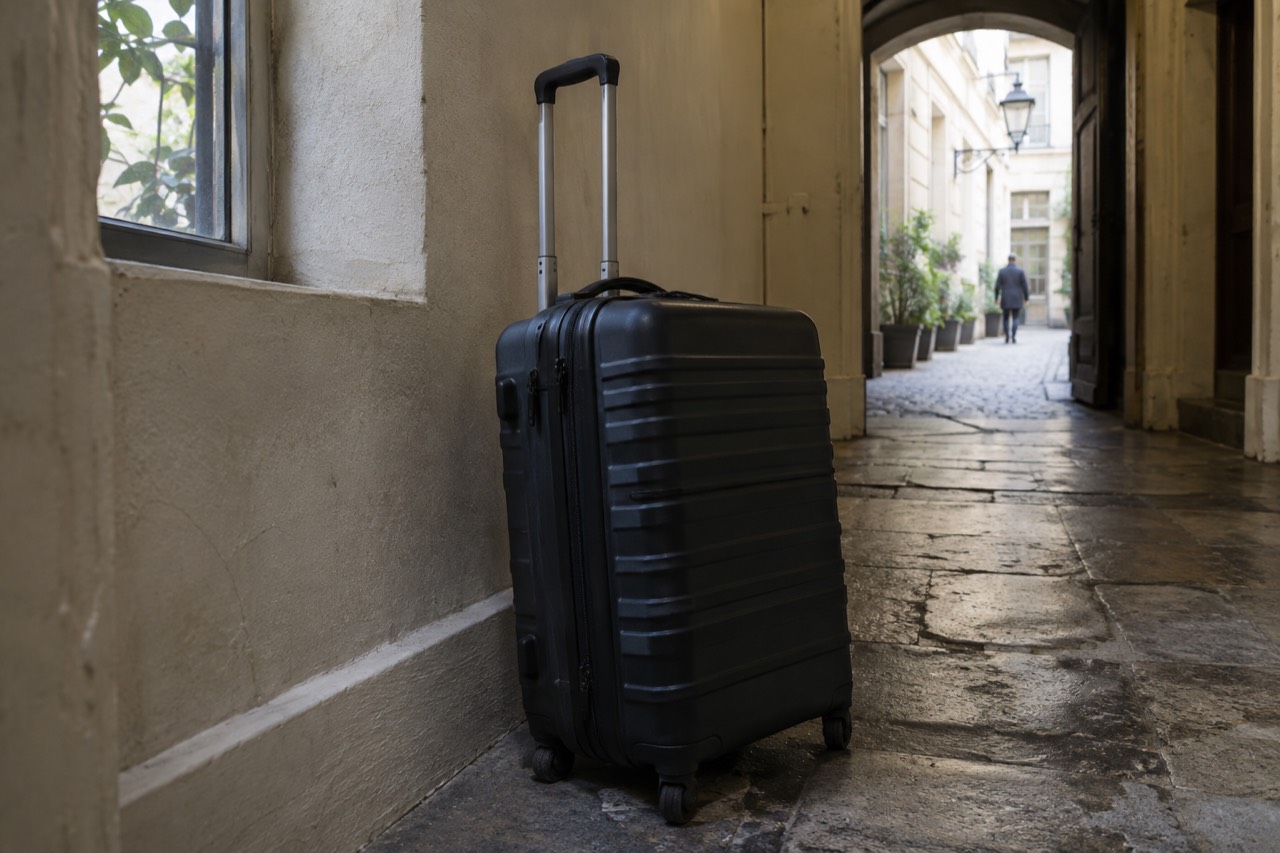
Is Hotel Luggage Storage Safe?
Hotel luggage storage is reasonably safe for bags you can afford to lose, since millions of travellers use it without incident. The real risk is not theft but the lack of a seal, itemised record, or meaningful recourse, with legal liability capped at one hundred times the nightly room rate, which is why a booked storage point with a written guarantee and paper trail is the safer choice.
The question usually arrives at the worst possible moment. You have checked out, your train leaves at eight in the evening, and the receptionist nods when you ask whether they can hold your suitcase. The nod feels like an answer, but it is not one. It tells you nothing about where the bag will sit, who else can reach it, what happens if it is damaged, or what the hotel legally owes you if it disappears. Luggage storage safety is mostly invisible until the day it is not, and by then every decision that mattered has already been made.
This article works through the question in the order that matters. First, what French law actually says a hotel owes you, because that is the number almost nobody knows. Second, what a real luggage room looks like behind the door, based on what is published rather than on reassurance. Third, how a booked luggage storage point compares, with the guarantee terms read closely rather than summarised from a marketing badge. Along the way it covers the practical steps that make either option safer, most of which take two minutes and cost nothing.
If your plan for the day runs through central Paris, the comparison is not abstract. Dropping a bag near the sights you are actually visiting, rather than backtracking to a hotel, is part of the safety calculation too: a bag sitting in a luggage room for eleven hours faces more risk than one you collect by mid-afternoon.
What French Law Actually Says A Hotel Owes You
French Civil Code article 1953 caps a hotelkeeper's liability for a guest's effects at one hundred times the daily room price, unless you can prove the loss came from the hotel's own fault. The cap moves with the price of the room, and the burden of proving fault, for damage, for theft or for anything in between, sits heavily on you.
That cap is the single most important fact in this whole debate, and almost no traveller has heard of it. The rule comes from the Civil Code's provisions on the necessary deposit, the legal regime that attaches to the clothing, luggage and effects of travellers who lodge at a hotel. Article 1953 states the cap in its third paragraph, to the exclusion of any lower contractual limit a hotel might try to impose, and a separate lower cap of fifty times the daily room price applies to objects left in vehicles parked on premises the hotel has exclusive use of. The details are set out in article 1953 as published on Legifrance, with a plain-language summary from the French consumer institute INC on hotel theft claims.
Two things follow from the cap, and they pull in opposite directions. The first is that the law does take hotel custody seriously: France decided centuries ago that an innkeeper answers for a guest's belongings, and it still does. The second is that the cap is a ceiling, not a promise. You still have to show what was in the bag, what it was worth, and ideally that the hotel failed in its duty. A suitcase handed over with no tag, no photograph and no list of contents is a suitcase whose contents you will struggle to prove you ever owned.
There is a harder edge for the after-checkout case. The legal regime of the necessary deposit attaches to travellers who lodge at the hotel. A bag held for three hours after checkout sits in a greyer zone, and whether the article 1953 cap applies at all to a former guest, or only to a current one, is a question French sources do not settle cleanly. It is a reasonable inference that a hotel holding a bag for someone who is no longer a guest is on ordinary contractual terms rather than the deposit regime, but that is reasoning, not settled law. The practical reading is the same either way: ask, at the desk, what the hotel's own policy is, and treat a shrug as information.
| Situation | What governs it | Practical ceiling on recovery | What you must prove |
|---|---|---|---|
| Guest's bag, held during stay | Civil Code arts. 1952-1953, necessary deposit | One hundred times the nightly room price | Contents, value, and ideally the hotel's fault |
| Guest's bag in hotel car park | Article 1953, fourth paragraph | Fifty times the nightly room price | Same, plus that the vehicle was on premises the hotel exclusively uses |
| Bag held after checkout | Grey zone; possibly ordinary contract terms | Unclear; possibly the same cap | Everything above, with less legal footing |
| Non-guest asking the desk | No published Paris chain policy exists | Unknown; likely ordinary bailment | That an agreement existed at all |
The last row is the one that surprises people. Despite how common the question is, no Paris hotel chain publishes a written luggage-holding policy for non-guests that this site's research could open. The answer at any given desk is a local decision, made in the moment, and it can change with the shift. If your whole day depends on it, that is a fragile foundation, which is a fair argument for a storage option you can book before you leave home.
For a fuller walkthrough of when hotels will hold bags at all, the companion guide on Paris hotel luggage storage policies covers check-in and checkout timing, and the question of non-guests is examined in whether a hotel holds luggage for non-guests. The short version: it varies, and "varies" is itself a safety fact.
What Actually Happens In A Hotel Luggage Room
In a typical Paris hotel, the luggage room is simply an unstaffed back room or corridor alcove where bags sit for hours, sometimes tagged, sometimes not, with no seal and no record of contents. This is custody with no evidence chain, so if two identical suitcases get swapped or one disappears, neither you nor the hotel can prove what happened.
The honest picture sits between two caricatures. The scary caricature, of open theft from luggage rooms, has essentially no sourced Paris data behind it: this site's research could not verify a single documented 2024 to 2026 incident at a Paris storage point or hotel bagagerie, and no theft statistics are published by the police prefecture, the interior ministry or the hotel trade. The reassuring caricature, that hotel storage is universally safe because hotels are reputable, is equally unsupported. What is verifiable is structural: the room is usually unattended, the bags are usually unsealed, and the record of what you handed over is usually a paper tag with a room number on it, if that. The wider set of guides lives on Luggage Storage in Paris.
Compare what a booked storage point does with the same bag. The Radical Storage network, which is what this site recommends, publishes a booking record: your name, the point, the dates, and a per-bag reference. Its terms require, as a condition of any claim, a signed list of the items in the bag with their estimated values. That requirement exists for the operator's protection as much as yours, but its effect is that a claim has an evidence chain from the first minute. A hotel luggage room has none of that, and no Paris hotel publishes a sealing or tagging procedure either, because none is required.
One structural detail is worth knowing: some Radical Storage Paris points are themselves hotels. The network's Paris page lists points typed "Hotel" alongside shops, restaurants and local companies, including a Hotel Paris Gare De Lyon card, and on the day this site's research fetched the page, one hotel point was showing as closed. The lesson cuts both ways. A hotel behind a counter is not automatically riskier than a shop behind a counter, and the difference that matters is not the type of business but whether the booking carries a written guarantee, recorded hours and a claim process. That is why this site states per-point hours from each point's own record and never generalises: hours vary, and a point that closes before your train does is a safety problem of a very literal kind.
Where you store also shapes how long the bag sits. A traveller who leaves a suitcase at a hotel in the 11th arrondissement and spends the day at the Louvre typically stores in the morning and retrieves in the evening, a long window in which nobody is looking at the bag. Storage Near The Louvre, by contrast, puts the drop-off within reach of the museum itself, with points rated 4.8 across 3,152 published reviews and hours running as early as 07:00 to as late as 22:00, so the bag can go down an hour before your timed entry and come back out an hour after it. Short custody windows are the most underrated safety measure in luggage storage, because most of what can go wrong requires time.
How A Written Guarantee Compares To A Hotel's Nod
Radical Storage advertises a EUR 10,000 guarantee, but its binding terms cap payment at EUR 3,000 per claim and state in plain words that the guarantee is not insurance, while claims require a signed itemised list, notification within seven days, and a police report within 48 hours for theft. That is a real, checkable process, which is precisely what a hotel luggage room does not offer, and the cap is the number to plan around, not the headline.
Read the terms closely, because the marketing badge will not give you any of this. Clause 9.2.2 of the Radical Storage terms and conditions says the guarantee "is not an offer to insure your property and does not constitute a contract of insurance", and clause 9.4 caps payment at EUR 3,000 per claim, valuing items at their current market value minus wear and tear, with sentimental value explicitly excluded. A reader deciding whether to leave a laptop in a bag needs the EUR 3,000 cap, not the EUR 10,000 headline, and this site always publishes the two together for exactly that reason.
The deadlines are stricter than most people expect. You must notify the company within seven days of discovering a loss or damage, or the guarantee is invalidated outright. The company then responds within three working days with one of three verdicts, invalid, pending or eligible, and if eligible you have ten days to complete the required steps. For theft or criminal damage, the police report is on a 48-hour clock from the moment you become aware of it. None of this is hidden, but none of it is on the booking page either, and a traveller who discovers a missing charger four weeks after the trip has already lost the claim before opening the email.
| Protection feature | Typical Paris hotel luggage room | Booked Radical Storage point |
|---|---|---|
| Written record of the deposit | Paper tag, sometimes nothing | Booking record with dates and per-bag reference |
| Record of contents | None | Signed itemised list with values, required for any claim |
| Liability cap | One hundred times the nightly room price (guests); unclear after checkout | EUR 3,000 per claim, not insurance |
| Claim deadline | None published | 7 days to notify; 48 hours to report theft to police |
| Sealing or tagging procedure | Not published by any Paris hotel | Not published; do not assume a seal |
| Opening hours | Desk hours, varies by property | Per point, from that point's own record |
The comparison is not a rout. For a short stop, the official SNCF consigne inside a mainline station is a strong alternative, and for guests mid-stay the hotel option costs nothing and the legal cap is often generous relative to a EUR 3,000 guarantee. The honest framing is that a hotel luggage room is a convenience with an implied duty of care, while a booked point is a service with a contract, and safety lives in the difference between implied and written. Neither is a vault. Do not leave cash, documents or jewellery in either one, a rule the venue world states openly: Disneyland Paris, for instance, disclaims liability for stored and carried belongings inside its parks in its own published rules.
The same logic applies to where you book. Near the Arc de Triomphe, the network's points hold a 4.73 rating across 1,327 reviews with hours from 09:00 to as late as 23:59, useful for a late dinner on the Champs-Elysees before a final retrieval. The rating is not a safety certification, and this site never treats review scores as audited figures, but a point with a thousand reviews and published hours is at least a known quantity, which is more than can be said for an unmarked door behind a hotel staircase.
How To Make Either Option Safer
Three habits cover most of the risk in any Paris luggage storage: photograph the bag's contents with values before you hand it over, keep valuables and documents on your person, and label the bag so an honest mistake cannot turn into an unclaimed item. All three are free, none takes more than a few minutes, and together they convert an unprovable loss into a documented one.
The itemised list deserves its own paragraph because it is the single most actionable tip in this article. Radical Storage's clause 9.8.1 excludes any claim where the company has not received a list of items, signed by the claimant, in which all items are individually listed with their estimated value. In other words, the guarantee you are counting on does not exist unless you wrote down what was in the bag before you dropped it. A phone video of the open suitcase, narrated, with the bag's identifying features in frame, does the same job for a hotel scenario where no such requirement exists but the burden of proof is entirely yours. Do it in the hotel lobby. It takes ninety seconds.
Labelling matters more than it used to, because French law changed the stakes. The law of 28 April 2025 created three tiers of fixed penalty for abandoned baggage across SNCF and RATP networks: EUR 72 rising to EUR 450 for involuntary abandonment, EUR 150 rising to EUR 750 where a bag carries no label, and EUR 180 rising to EUR 1,500 for manifest voluntary abandonment. Labelling is compulsory in SNCF stations, and a free anonymous QR-code label is now a permanent service in stations after a joint trial. A labelled bag is not only less likely to be mistaken for abandoned, it is easier to reunite with you when two identical suitcases are sitting in the same corner.
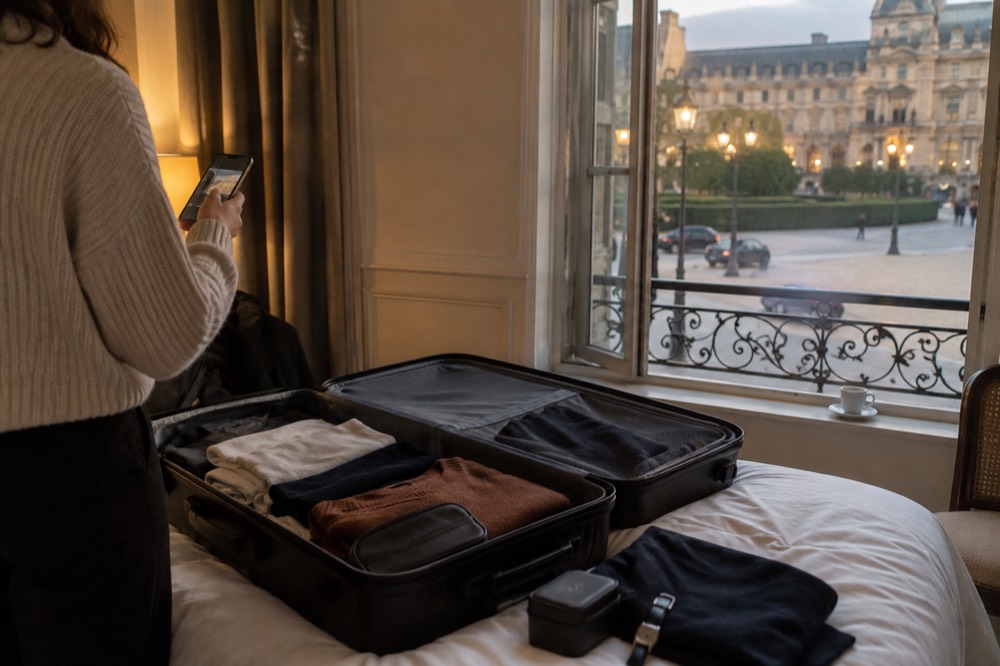
Beyond those three habits, timing does the rest. Store close to where you will actually be, so the custody window is short and the retrieval is not a cross-city expedition on your last evening. Check the point's own published hours rather than assuming, because hours vary per point and are often ordinary shop hours; the Radical Storage Paris page itself lists points like Gare du Nord Grandes Lignes at 08:30-20:00 and a Montparnasse point at 07:00-00:00, and any page promising storage around the clock in Paris is repeating a template, not a fact. And if your day ends at a monument, remember the venue rules: the Catacombs allow nothing larger than 40 x 30 x 20 cm with no cloakroom on site, and the Palais Garnier bans travel luggage outright during daytime visits, so the bag has to be somewhere else regardless of how safe your hotel is.
The cost of the booked alternative is knowable in advance. The standard Paris rate is EUR 3.90 per bag per day plus a EUR 1.99 per-bag checkout fee, so one bag for one day comes to EUR 5.89, and three days with one bag comes to EUR 13.69 because the fee is charged once per bag rather than per day. Those totals are arithmetic on the network's two published figures, not an observed checkout, and the fee appears at the checkout stage rather than on the location card. Whether that is worth it against a free hotel luggage room depends on what is in the bag; for a bag of laundry, it is not, and for a bag with a work laptop, it is not a close call.
For the broader question of how the network model works, including cancellation and what happens at the counter, the guide on how Radical Storage works in Paris covers the mechanics, and the safety question for storage points generally, as opposed to hotels specifically, is treated in whether Paris bag storage is safe. This site neither owns nor operates any storage point: every location recommended here is a Radical Storage partner location, and the comparison above only means something if you know who is making it.
So, is hotel luggage storage safe? For most bags, most of the time, yes, in the sense that nothing happens. But "nothing happened" is not a policy, and the day something does happen, the hotel offers you a legal cap and a burden of proof, while the booked point offers a contract with deadlines you now know. Choose on that basis, photograph the contents either way, and the question stops keeping you up at night.
Common Questions About Hotel Luggage Storage Safety
Is Hotel Luggage Storage Safe?
Usually, yes, in the unglamorous sense that most bags left in Paris hotel luggage rooms are collected unchanged. The real answer is about recourse rather than odds: an unattended room with no seal and no record of contents leaves you proving everything yourself against a legal liability cap, while a booked storage point gives you a written guarantee capped at EUR 3,000 per claim and a defined claim process. Neither is a vault, so keep valuables on you in both cases.
What is a hotel legally responsible for if my luggage is stolen?
Under French Civil Code article 1953, a hotelkeeper's liability for a guest's effects is capped at one hundred times the daily room price, unless you can prove the loss resulted from the fault of the hotel or of people it is responsible for. You must show what was in the bag and what it was worth, which is why photographing the contents before handing a bag over matters so much.
Is the Radical Storage guarantee the same as insurance?
No. Radical Storage's own terms, clause 9.2.2, state the guarantee is not an offer to insure your property and does not constitute a contract of insurance. The headline figure is EUR 10,000, but clause 9.4 caps payment at EUR 3,000 per claim, with items valued at current market value minus wear and tear and sentimental value excluded. This site always publishes the cap alongside the headline.
Will a hotel hold my bag after I check out?
Many do, for same-day collection, but no Paris chain publishes a written policy on it, and whether the legal liability cap still applies to a former guest is not settled. Ask at the desk what their policy is, note the answer, and if your day depends on it, a bookable storage point is the more reliable option.
What should I never leave in luggage storage?
Cash, passports and other documents, jewellery, medication you may need, and anything whose loss cannot be made good by EUR 3,000. The airport operator Bagages du Monde publishes the fullest prohibited list of any Paris storage operator, refusing hazardous, flammable, explosive or toxic products, weapons and ammunition, perishable goods, live animals, narcotics, counterfeit goods and radioactive or chemical items, with no refund on refusal.
How quickly do I need to report a problem?
With Radical Storage, within seven days of discovering loss or damage, and within 48 hours to the police if the bag was stolen, or the guarantee is invalidated. A hotel has no published deadline, but French consumer guidance on theft claims points the same direction: report fast, in writing, with evidence of contents.