How Much Luggage Can I Bring On The Paris Metro?
The Paris Metro no longer enforces a 75 cm luggage size limit. Here is what the rules actually say now, what the fines are for unlabelled bags, and when storing a case near the station is the better move.
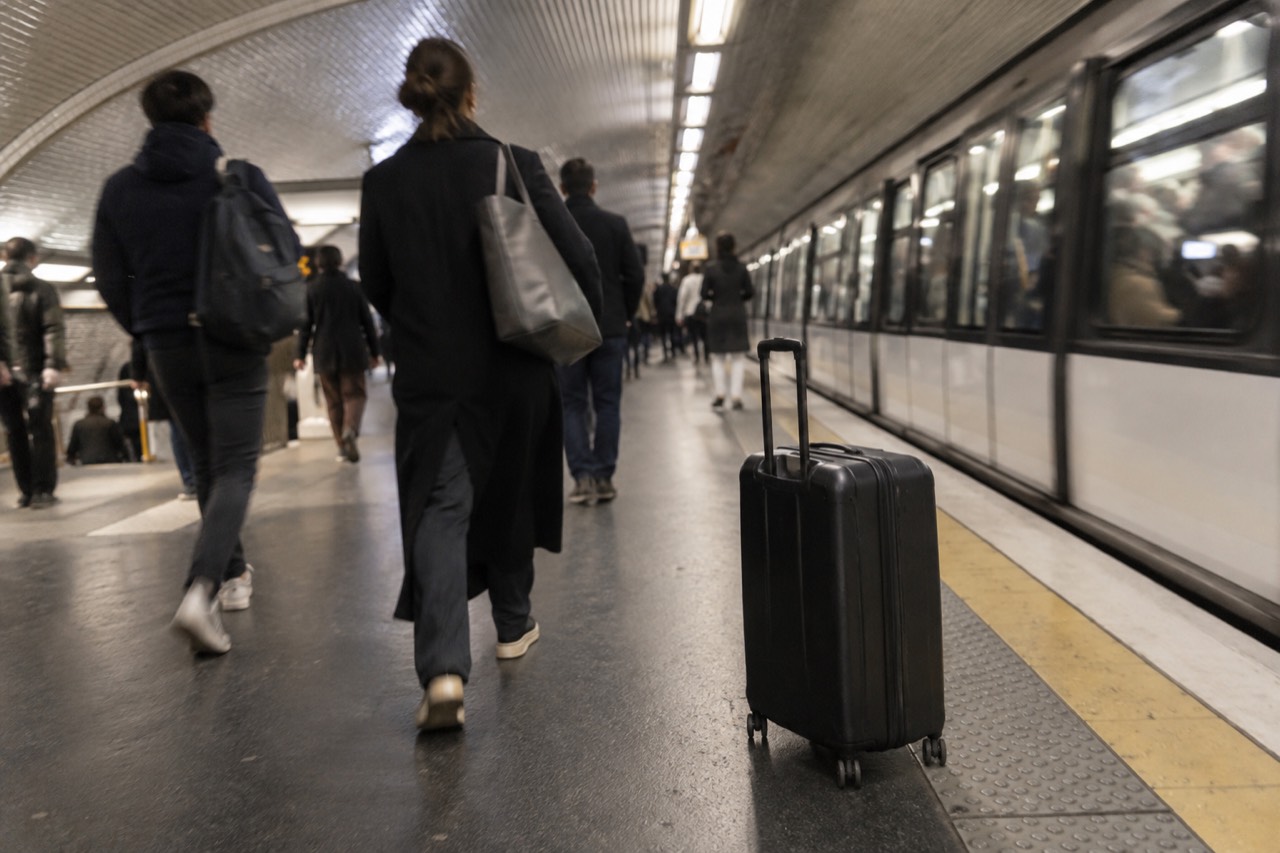
How Much Luggage Can I Bring On The Paris Metro?
There is no longer any size limit. A written government answer published in the Journal Officiel on 24 June 2025 states the RATP "n'applique plus de limitation de dimensions", so any bag you can carry yourself is allowed provided it does not obstruct other passengers or pose a danger. The old 75 cm rule, and the 150 EUR fine attached to it, belonged to an obsolete internal regulation that was formally dropped after a public controversy in spring 2025.
That answer came from the Ministry of Transport itself, in response to a written parliamentary question from deputy Caroline Colombier, and it settles a question that most English-language guides still get wrong. Search for Paris Metro luggage rules today and you will find page after page repeating the old line: bags over 75 cm banned, 150 EUR fine, skis and posters refused. All of that was true in April 2025. It stopped being true by the end of June 2025, and the source is not a blog or a forum but the French government's own published record, answer 17-6665QE, which you can read at the Assemblee nationale's page for the question.
The story behind the change matters, because it explains why the rule collapsed so quickly. On 7 May 2025 the RATP publicly restated the old internal regulation, the one banning any bag whose largest dimension exceeded 75 cm, with a 150 EUR fixed penalty attached. Within days, French media reported travellers being fined on their way to stations and airports with bags that were perfectly legal on the trains and planes they were heading to. A passenger fined for wheeling a suitcase to catch a TGV is exactly the kind of story that reaches parliament fast. The deputy's question was published in the Journal Officiel on 13 May 2025, and the ministry's answer, dropping the dimensional limit entirely, followed on 24 June 2025.
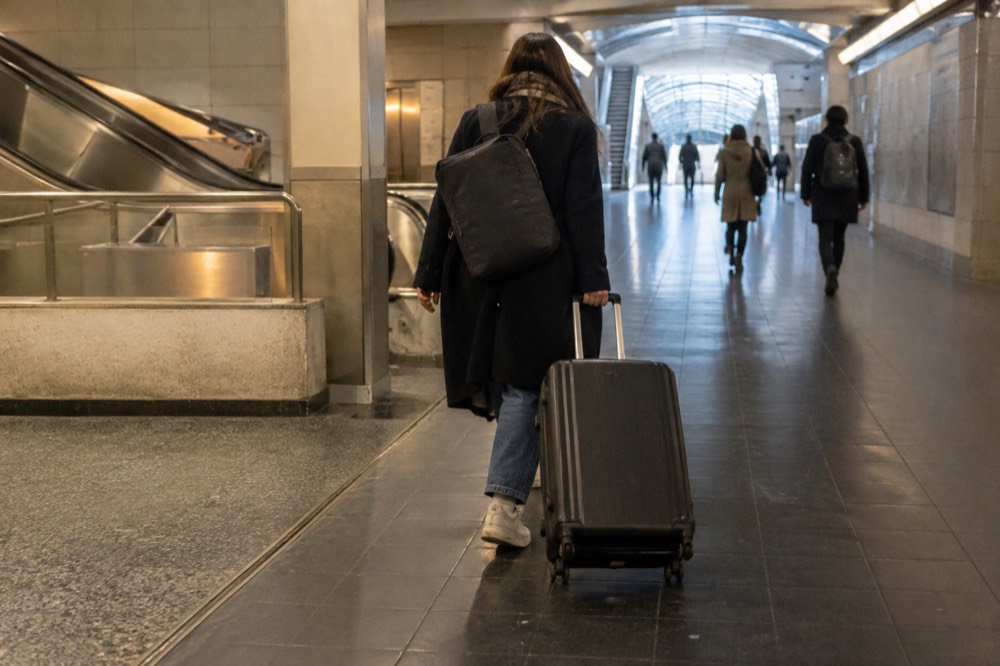
So the practical answer to how much luggage you can bring is: as much as you can physically manage, and no more. The rule that replaced the size ban is a nuisance rule, not a measurement rule. Your bag is allowed as long as it does not get in other people's way and contains nothing dangerous, a sharp or blunt object that could harm someone. A full-size checked suitcase is legal at any hour on any line. Whether it is wise is a different question, and the rest of this article is about that distinction, because the interchange between the rule and the reality is where most travellers actually struggle. Our companion guide on getting luggage onto the Metro and RER covers the practical side in more depth.
For anyone whose answer to "can I manage it" is no, the network of Radical Storage partner points around the central stations exists for exactly this moment. Every point is run by a real local business, a shop, hotel or cafe, holding your bag behind a counter as a Radical Storage partner location.
What The 75 Cm Rule Was, And Why It Died
The rule banned any bag whose largest dimension exceeded 75 cm, and any long object carried vertically such as skis or posters, under a 150 EUR fixed penalty. It came from an obsolete internal regulation restated on 7 May 2025, after travellers were fined carrying perfectly legal luggage to stations and airports. The Ministry of Transport confirmed on 24 June 2025 that the RATP no longer applies any dimensional limit.
The 75 cm threshold was never a law passed by parliament. It sat in the RATP's internal regulations, a document most passengers had never seen, and for years it was enforced sporadically enough that most people never encountered it. What made it explode into a national story in May 2025 was the combination of a formal restatement and a wave of fines at exactly the wrong moment. Travellers heading to Gare du Nord for a Eurostar, or to Gare de Lyon for a TGV, found themselves penalised on the Metro for bags that the train operator and the airline would both accept without comment. Eurostar's own allowance, for instance, permits bags up to 85 cm long on routes to and from London, a size the Metro rule would have refused.
The parliamentary question describes the sequence precisely. The rule was "issue d'un reglement interieur obsolete", drawn from an obsolete internal regulation, and it was restated officially on 7 May 2025 "a la suite d'une polemique mediatisee sur la verbalisation de voyageurs se rendant en gare ou a l'aeroport avec des bagages pourtant autorises dans les trains et avions". In plain terms: the fine wave came first, the controversy followed, and the government answer that arrived six weeks later removed the dimensional limit altogether. The ministry's framing is worth reading in full, because it tells you what the new standard actually is. Bags are authorised as long as they do not hinder other passengers and their movement through RATP spaces and vehicles, and carry nothing dangerous.
One caution for anyone reading older advice: the 150 EUR penalty for bulky luggage is still quoted on some pages as if it applies today. It does not, or at least the government answer says the rule it enforced no longer applies, and that is the most authoritative public statement available. What replaced it is not a free-for-all, though. The April 2025 transport security law created a separate set of penalties for bags that are left behind, and those are very much alive. If you are weighing whether to drag a case across the network or leave it somewhere, that law is the part you actually need to know, and it is the subject of the next section.
Wondering whether it is simpler to drop the bags before you ride at all?
What The 2025 Law Says About Bags You Leave Behind
The law of 28 April 2025 sets three penalty tiers for abandoned baggage on SNCF, RATP and other public carriers: 72 EUR, rising to 450 EUR, for involuntary abandonment, 150 EUR, rising to 750 EUR, where the bag carries no label, and 180 EUR, rising to 1,500 EUR, for manifest voluntary abandonment. Labelling is compulsory in SNCF stations, and a free anonymous QR-code label is available in stations.
This is the rule that actually bites travellers in 2026, and almost no English-language coverage mentions it. The law was reported in detail by MoneyVox in May 2025, and it applies to the RATP network, the Metro, RER and buses, just as it applies to mainline stations. The tiers are worth understanding, because the middle one catches people who have done nothing wrong on purpose. A bag left unattended for a moment, at a platform bench or beside a ticket machine, is treated far more harshly if it carries no label identifying its owner: 150 EUR rather than 72 EUR, and up to 750 EUR if it escalates.
| Situation | Base penalty | Maximum penalty |
|---|---|---|
| Involuntary abandonment of a bag | 72 EUR | 450 EUR |
| Bag carries no label | 150 EUR | 750 EUR |
| Manifest voluntary abandonment | 180 EUR | 1,500 EUR |
The free QR-code label is the practical tip buried inside this law. After a joint SNCF and RATP trial, a permanent service was set up offering anonymous labels, carrying only your surname, first name and phone number, obtainable free in stations. If you are travelling with bags through Paris, picking one up costs nothing and changes the legal category of any moment of inattention. It is also the difference between a bag that gets returned to you and a bag that triggers a security response.
And the security response is not a formality. SNCF publishes its own figures for what happens when a bag is left unattended in a station: announcements are made for the owner, and if nobody comes forward, the Vigipirate protocol applies, a security perimeter is set up pending sniffer dogs or law enforcement, and the whole procedure takes an average of 19 minutes per bag. The operator reports 360 items left behind on trains and in stations every week, and in 2022 alone, 35,500 trains were delayed or cancelled as a result of unattended luggage. Nobody is going to shrug at your suitcase while you buy a coffee. The era of parking a bag at the end of a platform and wandering off is over, and that is precisely why a staffed storage point, where handing over the bag is the whole transaction, has become the normal solution rather than a luxury.
Which Metro Line Is Step-Free With A Suitcase?
Metro line 14 is the only Paris Metro line that is fully accessible end to end, with lifts at every station and platform floors level with the trains. Every other line has structural constraints that predate the 2005 accessibility law, so a traveller with a heavy case should treat line 14 as the backbone of any luggage journey across the city.
This is the honest version of a question usually answered with a number nobody can source. Various pages claim an exact count of step-free stations across the network, but no official figure with a date could be verified, so it stays out of this article. What is well supported, by the RATP's own accessibility guidance and standard reference material, is the line 14 fact: it was built in the 1990s and 2000s to modern standards, and every one of its stations has lifts and level boarding. If your route allows it, line 14 is the line to plan around, and usefully for airport travellers, line 14 now reaches Orly, arriving near the Orly 3 left-luggage desk.
Every other line is a patchwork. Some stations have lifts, many have only escalators in one direction, and a large number have nothing but stairs, sometimes long spiral staircases built in 1900. The practical consequence is not that you cannot take luggage on those lines, the rule allows it, but that a single interchange can involve several flights of stairs with a 23 kg case. The gap between legal and pleasant is the entire subject here. A bag that is perfectly lawful on line 4 at Chatelet can still mean carrying it up and down through one of the deepest and most labyrinthine interchanges in the network.
That gap is also why luggage storage near the big interchanges has become such a common booking. Chatelet-Les-Halles is the largest Metro and RER interchange in central Paris, five Metro lines and three RER lines meeting under one complex, and it is exactly the kind of place where a suitcase stops being luggage and becomes an obstacle. Radical Storage lists 10 storage points around Chatelet-Les-Halles, rated 4.76 across 2,979 reviews, at EUR 3.90 per bag per day plus the EUR 1.99 per-bag checkout fee, so one bag for one day comes to EUR 5.89. Opening hours vary by point, with the earliest opening at 08:00 and the latest closing at 23:00, so the hours on the specific point you book are the ones that matter.
What Carrying A Case Through An Interchange Actually Involves
A Paris Metro interchange with a suitcase means stairs, long corridors, gates designed for single-file pedestrians, and crowds that do not slow down for anyone. Chatelet-Les-Halles alone links five Metro lines and three RER lines under one complex, and changing there with a full-size case can involve ten minutes of walking and multiple level changes before you reach your platform.
The physical reality deserves spelling out, because the rule change makes it sound as though the problem has been solved. It has not. The 75 cm limit is gone, but the network it applied to is unchanged: stations dug to 1900-era dimensions, corridors that run for hundreds of metres at the big interchanges, and ticket gates that a large wheeled case will not pass through sideways. There is no verified official guidance on which stations have wide access gates or how a traveller is meant to use one with a case, so the only honest advice is to expect the narrow ones and to allow time.
Consider a journey that is completely ordinary on paper: arriving at Gare de Lyon with a morning to spend near the Louvre before an evening train. On the map it is one RER A ride and a short walk. In practice it is Gare de Lyon's vast concourse, an escalator descent to the RER, a crowded platform, a transfer at Chatelet where the RER and Metro levels are connected by long passages and escalators, and then the streets. None of that is impossible, and millions of people do it. But it is the moment, standing in a moving crowd at the bottom of an escalator with a case that does not fit beside you, when most travellers start looking at their phones for somewhere to leave the bag.
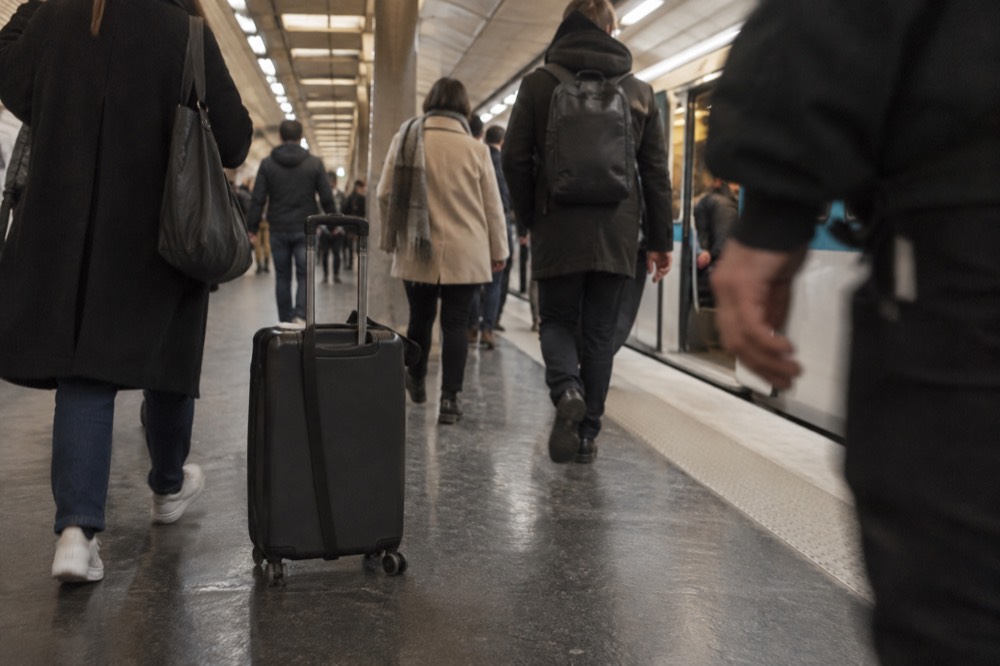
The storage arithmetic is worth doing before you decide. At Gare de Lyon, Radical Storage's 10 published storage points are rated 4.79 across 3,009 reviews, at the standard EUR 3.90 per bag per day plus the EUR 1.99 per-bag checkout fee. The official SNCF consigne at Gare de Lyon charges 5.50 EUR for a small locker and 9.50 EUR for a large one for a fixed 24 hours, which is cheaper for a long stop of several days but dearer for a single day, and SNCF states openly that its lockers "rencontrent un fort succes et peuvent ponctuellement etre completes", they are popular and sometimes full, with a card-only refit of the space announced for September 2026. A network point, bookable in advance with free cancellation before check-in, removes the capacity risk. For a fuller comparison, our guide to bag storage versus the station consigne works through the numbers station by station.
How Many Bags Can You Carry On Eurostar And TGV From Paris?
Eurostar allows 2 pieces of luggage plus 1 piece of hand luggage on Standard and Plus fares, 3 plus 1 on Premier, and 1 plus 1 for a child, with a maximum bag length of 85 cm on London routes and 75 cm elsewhere. There is no strict weight limit: Eurostar's own wording says that if you can carry it safely yourself, you are good to go.
The Eurostar allowance matters here for one reason: Gare du Nord is where the Metro, the Eurostar and the RER to the airport all meet, and it is the station where the old Metro rule clashed most visibly with the train rules. A London-bound passenger with two 85 cm cases was, in April 2025, legal on the train and at risk of a fine on the ride to it. That contradiction is what broke the rule. The allowance details come from Eurostar's own luggage page, and the no-weight-limit line is quoted from it directly.
Excess and oversized items are charged, which is often the moment a traveller decides to store a bag instead of carrying it. Additional bags cost from GBP 35, or EUR 30, with maximum measurements of 85 cm by 85 cm by 36 cm, and oversized items from GBP 60. Skis and snowboards can count as one of the two main pieces. If you are over the allowance and your extra bag is only needed later in the trip, leaving it in storage at the station end is usually cheaper than paying excess on it.
Eurostar also confirms, independently of SNCF, where the left-luggage facility at Gare du Nord actually is: lockers at the SNCF luggage office on the lower ground floor, next to platform 3 and opposite the exit marked Cour de taxis, open 06:15 to 23:15. That navigational landmark, opposite the taxi exit, is one SNCF's own page does not give. Around the station, Radical Storage lists 10 storage points rated 4.75 across 2,937 reviews, at EUR 3.90 per bag per day plus the EUR 1.99 fee, with the earliest point opening at 07:30. Our guide to Eurostar baggage and storage at Gare du Nord covers the full picture for that station.
When Storing The Bag Beats Dragging It
Store the bag when your day involves a Metro interchange, a museum with a size limit, or a gap between hotel checkout and a night train. No major Paris museum or monument accepts a full-size suitcase: the Louvre caps bags at 55 x 35 x 20 cm, the Catacombs at 40 x 30 x 20 cm with no cloakroom at all, and the Eiffel Tower, Arc de Triomphe and Sainte-Chapelle have no left-luggage facility of any kind.
The venue rules are the quiet half of this story. The Metro will now take any bag, but almost nothing at the other end of the ride will. The Louvre's free lockers beneath the Pyramid are for smaller items only, and anything exceeding 55 x 35 x 20 cm is not permitted in the museum at all, with items left in the lockers to be collected the same day. The Catacombs are stricter still, 40 x 30 x 20 cm, bags carried in front or at your side, and no cloakroom, which is structural: the exit is 700 m from the entrance, so there is nowhere on site to put anything. The Eiffel Tower has no left-luggage office, no cloakroom and no lockers, with a physical gauge at security deciding what passes. A traveller who rides the Metro legally with a full suitcase and then tries to enter any of these venues has simply moved the problem, not solved it.
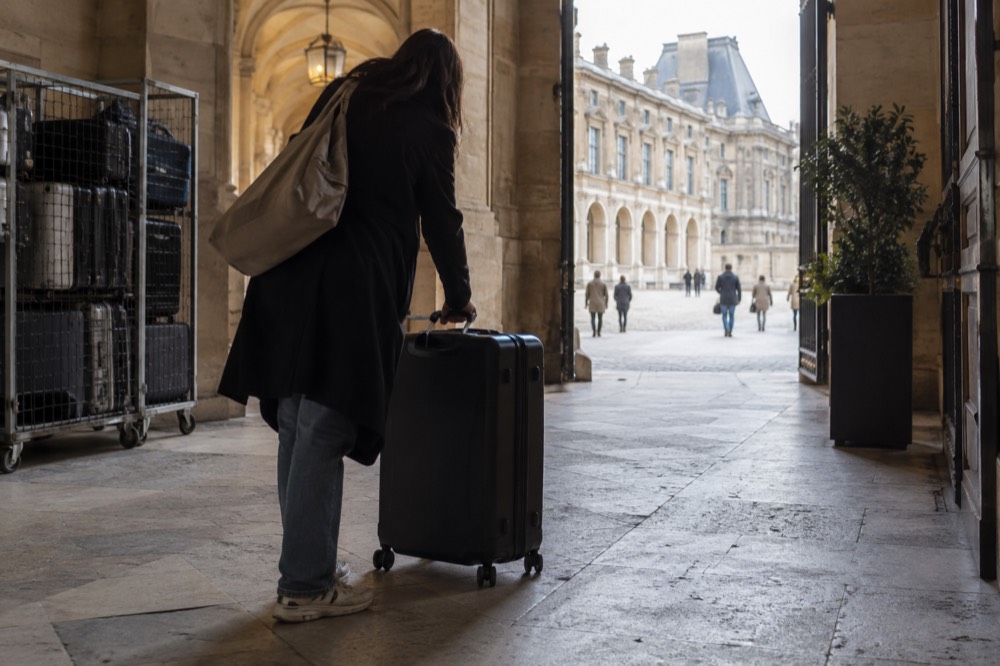
That is the sequence that pushes most people to a storage point: legal on the Metro, unwelcome at the museum, unwelcome at the restaurant, and the hotel checkout was at noon. The Radical Storage network exists for exactly that gap, and this site, Luggage Storage in Paris, is built around it. Every point is a real partner business, and the network's guarantee is advertised at EUR 10,000 but capped at EUR 3,000 per claim in the terms, which are not insurance, a distinction worth knowing before you leave a laptop in the bag. Claims must be notified within seven days, and theft must be reported to the police within 48 hours, so photograph your bag's contents with values before you hand it over: a signed itemised list is a condition of any claim.
At Gare Montparnasse, another of the big interchange stations where Metro lines 4, 6, 12 and 13 meet the mainline and the airport buses, Radical Storage shows 10 storage points rated 4.62 across 818 reviews, at the standard EUR 3.90 per bag per day plus the EUR 1.99 per-bag checkout fee. The official SNCF consigne there is card-only, 5.50 EUR small and 9.50 EUR large for an indivisible 24 hours, so for a single day the network price of EUR 5.89 total sits between the two locker sizes, and the network point can be reserved in advance while the lockers cannot. For a longer stop, three days with one bag works out to EUR 3.90 x 3 plus EUR 1.99, or EUR 13.69, against EUR 15.50 for a small SNCF locker at the same duration, because the per-bag fee is charged once and does not scale with nights.
The pattern across every station is the same: the official consigne wins on price for multi-day stops where you can pay the right way in coins or card, the network points win on bookability, hours and the stations where no consigne exists at all, and both beat dragging a case through Chatelet at rush hour. If your plan involves more than one interchange, or any museum, or a dinner where a suitcase beside the table would be a problem, the storage point is not an indulgence. It is the difference between a day in Paris and a day managing a bag.
Common Questions About Luggage On The Paris Metro
How Much Luggage Can I Bring On The Paris Metro?
There is no size limit any more. A government answer published on 24 June 2025 confirms the RATP no longer applies any dimensional restriction, so any bag you can carry yourself is permitted as long as it does not obstruct other passengers or contain anything dangerous. The old 75 cm rule and its 150 EUR fine no longer apply.
Can I bring a suitcase on the Paris Metro?
Yes, a full-size suitcase is allowed on every Metro line. The only conditions are that you can carry it yourself, it does not block other passengers, and it contains nothing dangerous. Line 14 is the only fully step-free line, so plan around it where you can.
What are the Paris Metro luggage rules in 2026?
The dimensional limit is gone, but the law of 28 April 2025 penalises abandoned bags: 72 EUR for involuntary abandonment, 150 EUR if the bag carries no label, and 180 EUR for manifest voluntary abandonment, each with a higher maximum. A free anonymous QR-code label is available in stations and is worth picking up.
Is there a weight limit for luggage on the Paris Metro?
No weight limit is published for the Metro. Eurostar, for comparison, also has no strict weight limit, its own page says that if you can carry it safely yourself, you are good to go, though it caps the number and length of bags.
Can I leave my bag on the platform for a few minutes?
No. An unattended bag triggers the Vigipirate protocol: announcements, a security perimeter, sniffer dogs or law enforcement, and an average of 19 minutes of disruption per incident. Fines under the 2025 law start at 72 EUR and rise steeply if the bag is unlabelled. Use a staffed storage point instead.
Where can I leave a suitcase near a Metro interchange?
Radical Storage partner points sit around the big interchanges: 10 points at Chatelet-Les-Halles, 10 at Gare de Lyon, 10 at Gare Montparnasse and 10 at Gare du Nord, all at EUR 3.90 per bag per day plus a EUR 1.99 per-bag checkout fee. Hours vary by point, so check the specific location before booking.