Where To Store Luggage In Paris Overnight And For Multiple Days
A multi-night booking is often the cheapest way to store a bag in Paris, and it is the version of the service that fewest travellers plan for. The per-bag fee is charged once, not per night, which changes the arithmetic completely.
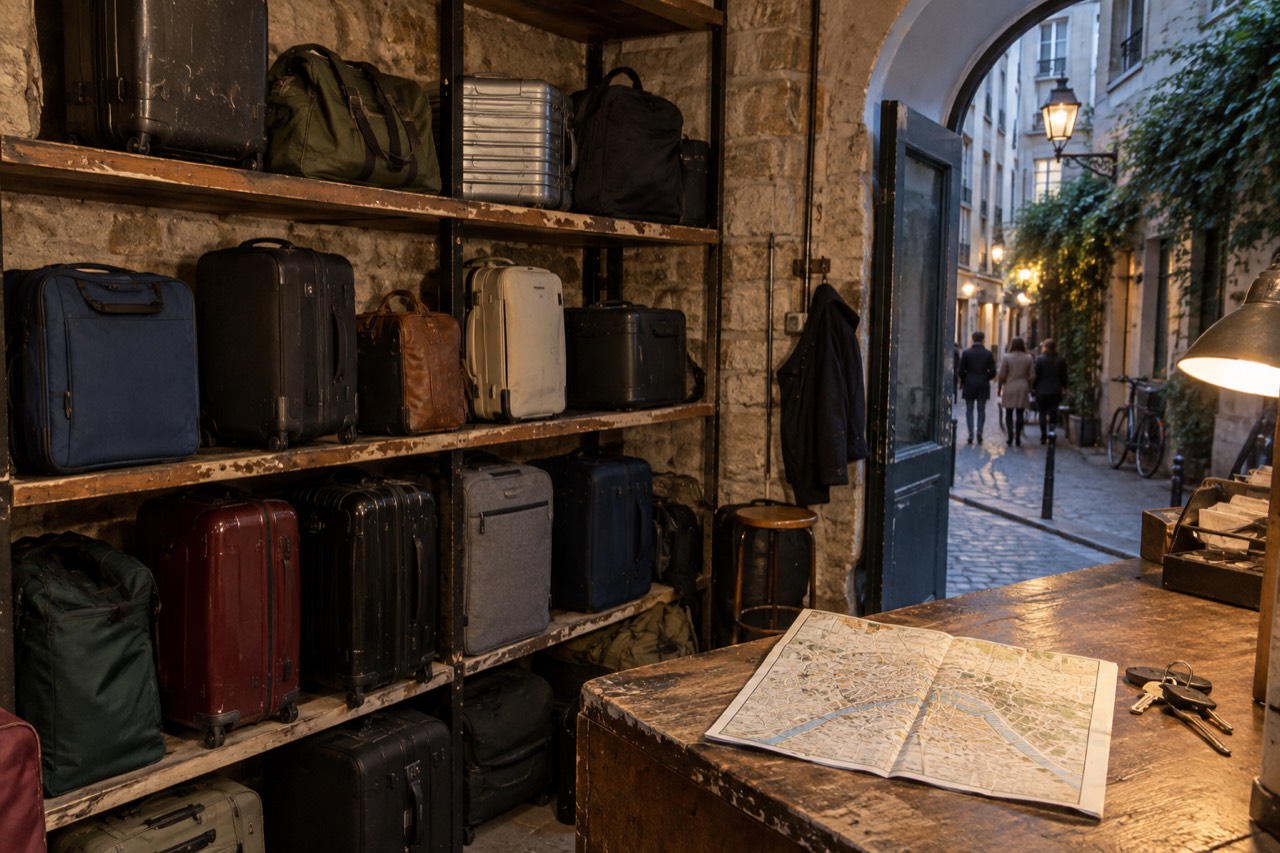
Short answer
You can leave luggage overnight in Paris at more than 370 Radical Storage points, paying EUR 3.90 per bag per day plus a one-time EUR 1.99 per-bag fee. One bag for one day totals EUR 5.89, and three days totals EUR 13.69. Bookings can be cancelled free of charge before check-in and carry a guarantee capped at EUR 3,000 per claim.
Why Overnight Storage Is A Practical Choice In Paris
Most travellers do not need storage for an afternoon. They need it for the gap between a morning checkout and a train the next day, or for three nights while they travel to the Loire with a smaller holdall. Paris has more than 370 Radical Storage points that accept multi-day bookings, and the small per-bag fee is charged once rather than per night.
Paris hotels run on an afternoon check-in and a morning checkout, and plenty of stays are built around a night somewhere else: Reims, Rouen, the Loire, a wedding outside the city. That pattern leaves a suitcase with nowhere to live. A hotel bag room will sometimes hold a case for a few hours on the day you leave, but almost none publish a policy for holding it overnight, and even fewer accept a bag from someone who is not staying there. A bookable storage point is the version of that arrangement a traveller can actually plan around.
Three situations come up again and again. The first is a late departure: checkout at 11:00, flight or train at 21:00, and a bag that needs to be somewhere for ten hours. The second is a short side trip, with two or three nights booked in Paris either side of a trip out of the city and the largest case staying behind. The third is a station change, arriving at Gare du Nord in the morning and leaving from Gare Montparnasse the following day. All three work better with a multi-day reservation than with a same-day drop.
The points listed through Luggage Storage in Paris are all part of the Radical Storage network, which means a shelf inside a shop, hotel or café counter can be reserved in advance. This site does not own or operate any of them; every one is a Radical Storage partner location. That is the whole relationship, and it is worth stating plainly, because a traveller is handing a stranger a suitcase and is entitled to know whose guarantee sits behind it.
The pricing is where a longer stay gets interesting. Because the day rate is multiplied by the nights and the per-bag fee is not, three nights cost barely twice what a single afternoon costs. the full breakdown of Paris storage prices covers the components; the arithmetic below is the part that matters once a stay runs past one night.
How Much Does Multi-Day Luggage Storage Actually Cost?
The standard Paris rate is EUR 3.90 per bag per day, and a one-time EUR 1.99 per-bag fee is added at checkout. One bag for one day therefore costs EUR 5.89, and three days cost EUR 13.69, because the fee is charged once per bag rather than once per night. Every night after the first adds only EUR 3.90.
Two figures do all the work here. The day rate is EUR 3.90 per bag, and the booking fee is EUR 1.99 per bag, charged once. That fee is not a nightly charge and it does not scale with the length of the stay, so the cost of a booking is the day rate multiplied by the number of nights, plus EUR 1.99 per bag. Nothing else is added: there is no size surcharge, no weight limit published anywhere on the Paris network, and no late-collection penalty.
The table below shows how that builds up across the periods travellers actually book.
| Nights stored | What you pay for one bag |
|---|---|
| 1 | EUR 3.90 for the day plus the one-time EUR 1.99 fee, a total of EUR 5.89 |
| 3 | EUR 3.90 for each of the three days plus the one-time EUR 1.99 fee, a total of EUR 13.69 |
| 5 | EUR 3.90 for each of the five days plus the one-time EUR 1.99 fee |
| 7 | EUR 3.90 for each of the seven days plus the one-time EUR 1.99 fee |
The fee is charged per bag, not per booking, so two bags for three days means the EUR 1.99 applies twice. That still leaves the network cheaper than any alternative that prices per bag per night, because nothing compounds.
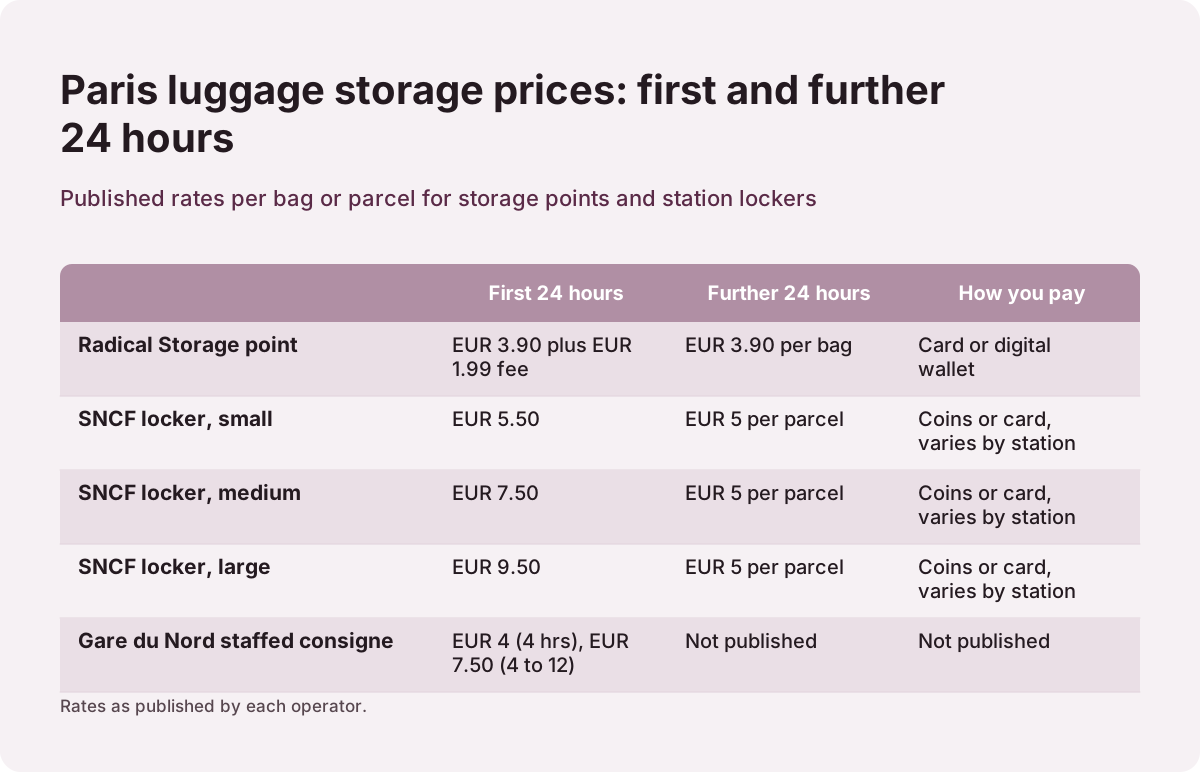
The honest comparison is with the official SNCF station consigne, which is the only other published Paris option with real numbers behind it. At Gare de Lyon a small locker costs EUR 5.50 for the first fixed 24 hours and then EUR 5 per parcel for each additional 24-hour period. At Gare du Nord the staffed counter publishes duration pricing instead: EUR 4 for up to four hours, EUR 7.50 for four to twelve hours, and EUR 9.50 for twelve to twenty-four hours, with no multi-day grid published at all.
| Option | First 24 hours | Each further 24 hours | How you pay |
|---|---|---|---|
| Radical Storage point | EUR 3.90 per bag, plus a one-time EUR 1.99 per bag | EUR 3.90 per bag | Card or digital wallet |
| SNCF locker, small | EUR 5.50 | EUR 5 per parcel | Coins or card, varies by station |
| SNCF locker, medium | EUR 7.50 | EUR 5 per parcel | Coins or card, varies by station |
| SNCF locker, large | EUR 9.50 | EUR 5 per parcel | Coins or card, varies by station |
| Gare du Nord staffed consigne | EUR 4 for up to 4 hours, EUR 7.50 for 4 to 12 hours, EUR 9.50 for 12 to 24 hours | Not published | Not published |
For a single afternoon the station locker can be the cheaper of the two, because a bag left for three hours at Gare du Nord is EUR 4 in coins rather than EUR 5.89 on a card. For anything past the first night the picture flips, and it flips hard. the official station consigne compared walks through the same numbers station by station.
Two practical points sit behind those figures. SNCF states on its own pages that station lockers sell out and can be closed for works, so a locker is never a guaranteed option on a busy Friday. And the Radical Storage fee does not appear on the Paris landing page at all: it appears at the checkout screen, which is the moment a traveller first sees the true one-day price rather than the headline day rate.
Where To Find 24-Hour And Overnight Bag Storage In Paris
Paris has more than 370 Radical Storage location pages, and the published opening windows vary widely between them. Earliest opening times across the network run from midnight to 09:00, and latest closing times run from 21:00 to 23:59. A card that reads midnight to midnight does not mean a staffed desk is open all night; it means that point's own schedule reaches those hours.
Hours come from each point's own record, never from a network-wide rule, and that distinction matters more for an overnight booking than for any other kind. What follows is the spread of earliest opening and latest closing times across the biggest Paris clusters.
| Storage cluster | Published points | Earliest listed open | Latest listed close |
|---|---|---|---|
| Gare du Nord | 16 | 07:30 | 23:59 |
| Gare de Lyon | 12 | 00:00 | 23:59 |
| Gare Montparnasse | 13 | 07:00 | 23:59 |
| Montmartre and Pigalle | 13 | 00:00 | 23:59 |
| Le Marais | 10 | 00:00 | 23:59 |
| Louvre | 6 | 07:00 | 22:00 |
| Eiffel Tower | 7 | 07:30 | 23:59 |
For a bag being collected the following morning, a station cluster is usually the right answer, because the drop-off and the pick-up both happen within a short walk of a platform. For a bag being dropped the evening before an early departure, a district point can be better: several in Le Marais and the Latin Quarter list earlier opening hours than the shops inside the stations, and a point that opens at 05:00 or 06:00 is worth more at that hour than one next to a track.
The Gare du Nord cluster deserves a separate word, because it is where the highest volume of overnight demand sits. Ten Radical Storage points serve the station, and those ten storage points published on this site carry a combined rating of 4.75 from 2,937 reviews. The point closest to the Eurostar side keeps shop hours, opening at 08:30 and closing at 20:00, which rules it out for a late-night or pre-dawn collection. A traveller who needs either of those should look at the district clusters instead and treat the walk as part of the plan.
The same logic applies around the Eiffel Tower, where 9 points serve one of the busiest evening districts in the city (see Eiffel Tower Backpack Rules). This cluster suits a specific pattern: drop the bag in the morning, spend the day and the evening on the Champ de Mars, and collect after a late Seine cruise. The latest listed close in the cluster is 23:59, and the earliest listed open is 07:30, so a bag dropped early and collected late is comfortably inside a single day.
There is no Radical Storage point at Charles de Gaulle or at Orly. Both airports route arriving travellers to the station clusters instead, and a bag cannot be dropped at either airport through this network. A traveller landing at CDG in the morning and heading into the city should book near Gare du Nord, and one landing at Orly should look at the Left Bank clusters around Montparnasse and Austerlitz.
What Makes A Storage Point Reliable For A Longer Stay
A longer stay puts more weight on the guarantee behind the booking, so the conditions are the part worth reading. The guarantee pays up to EUR 3,000 per claim, not the EUR 10,000 used in marketing. A claim must be made within seven days of discovering the loss, the contents must be itemised with estimated values before drop-off, and a theft must be reported to the police within 48 hours.
The guarantee is a promise made by the company itself rather than a policy issued by a third-party underwriter, and the terms state plainly that it is not an offer to protect property in the way a formal policy would. The two figures are always written together for that reason: EUR 10,000 is the headline, EUR 3,000 is the ceiling that applies when a claim is assessed. A traveller leaving a laptop, a camera or a piece of jewellery should weigh the bag's contents against that ceiling before handing it over.
| Condition | What it says |
|---|---|
| Maximum payable per claim | EUR 3,000 |
| Marketing headline figure | EUR 10,000, which is not payable in full |
| Time to notify a loss | Within seven days of discovering it |
| Police report for theft | Within 48 hours of becoming aware |
| Item list | Required before drop-off, with estimated values |
| Valuation basis | Current market value minus wear and tear |
The single most useful piece of practical advice on this page comes out of those terms. Photograph the contents of the bag with a phone before it is handed over, and note an estimated value for each item. A signed, itemised list is a condition of any claim under the terms, and it is the step almost every first-time user skips. The same terms exclude anything not packed reasonably safely, and exclude damage that happens while the bag is being moved inside the storage space during the booking period.
The second deadline is tighter than the first and catches people out. If a bag is stolen, a police report has to be filed within 48 hours of the innocent party becoming aware of the theft. Seven days is the window for telling the company; 48 hours is the window for the police. A three-night booking therefore carries a slightly different risk profile from a three-hour one, simply because there are more hours in which a bag could go missing and more days in which the 48-hour clock could start unnoticed.
Storing A Bag For A Day Trip, An Overnight Stay, Or A Long Weekend
A day trip is the classic case for leaving something behind. Disneyland Paris refuses bags larger than 55 by 40 by 25 cm at the gates and charges EUR 5, EUR 11 or EUR 15 per item per day at its own Guest Storage, which cannot be reserved in advance. The Chateau de Versailles caps bags at 55 by 35 by 20 cm, and its free lockers measure 30 by 49 by 50 cm inside.
Almost every major Paris destination publishes a bag limit, and almost every limit is smaller than a checked suitcase. That is the whole reason a day trip turns into a storage problem.
| Venue | Maximum bag size | On-site storage |
|---|---|---|
| Louvre | 55 x 35 x 20 cm | Free lockers under the Pyramid and at Porte des Lions, collected the same day |
| Disneyland Paris | 55 x 40 x 25 cm | Guest Storage at EUR 5, EUR 11 or EUR 15 per item per day, no advance booking |
| Chateau de Versailles | 55 x 35 x 20 cm | Free lockers, interior 30 x 49 x 50 cm |
| Catacombs of Paris | 40 x 30 x 20 cm | None, and the exit sits 700 m from the entrance |
| Palais Garnier | Travel luggage not allowed | Cloakroom opens for performances only |
| Eiffel Tower | Not published | No cloakroom and no left luggage |
| Arc de Triomphe | 40 x 40 x 20 cm | None |
Disneyland Paris is the sharpest example, because its own rules go further than a size limit. the theme park rules state that employees are not authorised to keep luggage anywhere except the storage facility and some dedicated boxes, which closes off the idea that a member of staff will watch a case while you ride. The facility itself sits to the right of the Disneyland Park entrance, opens daily from 8am, closes 45 minutes after the park closes, and cannot be booked ahead. A day-tripper who arrives on a busy morning has no way to reserve a slot.
Versailles is more forgiving on price and less forgiving on size. The estate provides free lockers in the North Ministers' Wing, but the interior measures 30 by 49 by 50 cm and the maximum bag permitted anywhere on the estate is 55 by 35 by 20 cm. A standard cabin case will not pass. A full-size checked suitcase certainly will not.
The pattern that works uses Paris as a base rather than a stop. Leave the big case at a storage point near your station for the whole side trip, take a smaller bag with you, and come back to it. Two nights away with one bag held in Paris costs the day rate twice plus the one-time fee, which is less than most people assume, and it removes the need to solve a storage problem at the far end of the journey at all. A day trip works the same way on a smaller scale: leave the case, travel with a compliant bag, and collect it on the way back to the hotel.
For an overnight specifically, the risk is not cost but timing. A bag held overnight has to be collected during the point's published hours the following day, so a return train that lands at 23:00 needs a point that closes at 23:59 rather than 20:00. Several Gare de Lyon and Gare Montparnasse points list a 23:59 close, and the Marais cluster offers the widest spread of both early and late hours.
Around Gare de Lyon the combination is unusually good for multi-day use. Ten published points serve the station, carrying a combined rating of 4.79 from 3,009 reviews, with an earliest listed open of midnight and a latest listed close of 23:59. That range covers an early TGV out and a late one back, and it covers a bag held across three nights while the traveller is somewhere else entirely.
The Smart Multi-Day Arithmetic: Why The Fee Works In Your Favour
The fee structure is what makes a long stay cheap. A five-night booking pays the EUR 3.90 day rate five times and the EUR 1.99 fee once, so the cost per night falls the longer the bag stays. An SNCF locker, by contrast, charges a fresh 24-hour block plus EUR 5 per parcel for every additional period, so its cost climbs in step with the nights.
Put plainly: the first night costs the day rate plus the whole of the fee, and every night after that costs only the day rate. The relative penalty for the fee shrinks with each night added, which is why a long weekend ends up looking cheap against almost any alternative. The same is not true of a locker, where the first 24 hours and every subsequent 24 hours are charged at the same published step, plus the EUR 5 per-parcel top-up.
There is a second effect worth naming. A station locker is rented in indivisible 24-hour blocks, so a bag dropped at 18:00 and collected at 09:00 the next morning is charged for a full block it barely used. Network bookings run on dates rather than precise hours, so that fourteen-hour overnight counts as one day. Two late arrivals and early departures across a week can save a locker user nothing at all and a network user two full blocks.
The honest counterweight is that the official consigne is genuinely cheaper for a very short stop. A bag left at Gare du Nord for three hours costs EUR 4 in coins, against EUR 5.89 for a network booking made for the day. Anyone weighing the two should work out how long the bag actually needs to be away before choosing, and should keep in mind that the SNCF lockers run on coins or cards depending on the station, while the network takes cards and digital wallets everywhere.
At Saint-Lazare and Bercy the comparison does not arise at all. Neither station has an in-station consigne, per SNCF's own list of the thirteen major stations that do, and both are handled by an off-site partner instead. That is the strongest honest reason to book ahead in that half of the city: there is no locker to fall back on.
How To Book Multi-Day Storage In Under Two Minutes
Booking a multi-day slot takes the same steps as booking an afternoon. Choose a point on the map, set the number of bags, select the start and end dates, and pay. The calendar does the arithmetic: the EUR 3.90 day rate is multiplied by the nights selected, and the EUR 1.99 per-bag fee is added once at the final screen.
The flow is deliberately short. Pick a location near a hotel, station or meeting point, choose the bag count, set the date range, and pay by card or digital wallet. Confirmation arrives by email with the full address of the point, its exact opening hours for those dates, and a code for check-in. The digital record doubles as proof of deposit, which matters if a claim ever has to be made.
The one thing the booking flow does not show early is the fee. The day rate is what appears throughout the search and selection screens; the EUR 1.99 per bag is added at checkout. That is worth knowing in advance so the final total is not a surprise, and it is the reason this page always quotes the two figures together rather than the day rate alone.
Anyone who wants the mechanics in more detail will find them in how the Radical Storage network works, which covers what the partner locations actually are and how a bag is handled on arrival. The short version: partners are shops, hotels and cafés holding bags behind a counter, not rows of self-service lockers, so a bag is handed to a person and handed back by a person.
For a stay of three nights or more, two habits are worth building in. First, check that both the drop-off day and the collection day sit inside the point's weekly hours, because a shop that closes on Sunday will not hand back a bag on Sunday. Second, book the full span upfront rather than extending later, since a point with a reserved shelf is a point with a shelf.
Gare du Nord is the natural booking for anyone arriving by Eurostar, and it is also the cluster with the deepest inventory: the 10 storage points this site publishes there rate 4.75 across 2,937 reviews, and opening windows start as early as 07:30 and run as late as 23:59. A bag dropped there at the start of a Paris stay and collected at the end of it is the simplest version of a multi-day booking there is.
A bag reserved for several nights is also a bag that is not being carried across the city at rush hour, which matters more than it sounds. The RATP no longer enforces a dimensional limit on the Metro, having told the National Assembly that it has dropped the old 75 cm rule, but a large case on a crowded Line 1 at 18:00 is still an unpleasant experience for everyone in the carriage. Storing the bag and travelling with a daypack is the version of the trip that most people end up preferring.
Common Questions About Overnight And Multi-Day Bag Storage In Paris
Where Can I Store Luggage In Paris Overnight?
More than 370 Radical Storage points across Paris accept overnight bookings, spread across the station clusters, the Marais, Montmartre and the landmark districts. The best clusters for an overnight are around Gare du Nord, Gare de Lyon and Gare Montparnasse, where published closing times reach 23:59. Check the individual point's hours before booking, because a shop-based point that closes at 20:00 will not work for a late collection.
How Much Does It Cost To Store Luggage For 24 Hours In Paris?
One bag stored for a full day costs EUR 3.90 plus a one-time EUR 1.99 per-bag fee, a total of EUR 5.89. There is no size surcharge and no weight limit published anywhere on the Paris network. The same bag held for three days costs EUR 13.69, because the fee is charged once rather than once per night.
Is There Cheaper Long-Term Luggage Storage In Paris?
For a single afternoon the official SNCF station consigne can beat the network: a bag left at Gare du Nord for up to four hours costs EUR 4, against EUR 5.89 for a day booking. Past the first night the position reverses, because the consigne charges a fresh 24-hour block plus EUR 5 per parcel for each additional period, while the network adds only EUR 3.90 per night.
Can I Leave My Luggage At A Paris Hotel For Several Days?
Most Paris hotels will hold a guest's bag on the day of checkout, and very few publish a written policy for holding a bag overnight or for several days. Where a hotel does agree, the legal protection a guest normally has under French civil code article 1952 attaches to travellers who lodge at the property, so a bag left by a non-guest sits on different footing. A booked storage point avoids the question entirely.
Is It Safe To Store A Bag In Paris For Multiple Days?
The network booking carries a guarantee capped at EUR 3,000 per claim, and the conditions are the part that matters. Contents must be itemised with estimated values before drop-off, a loss must be reported to the company within seven days of discovery, and a theft must be reported to the police within 48 hours. Items are valued at current market value minus wear and tear, and sentimental value is not counted.
What Happens If I Need My Bag After The Storage Point Closes?
A bag cannot be collected once the point has closed for the day, so the drop-off and the collection both have to sit inside that point's published hours. A booking runs on dates rather than precise hours, so a bag dropped at 10:00 and collected at 23:00 on the same date still counts as one day. For a multi-night stay, choose a point whose weekly schedule covers both the day you arrive and the day you return.